1. Introduction and Purpose
The Michigan Center for Adult College Success (The Center) invites qualified consultants, research organizations, or collaborative teams to submit proposals to conduct a comprehensive inventory and assessment of organizations providing education, training, credentialing, workforce development, and related support services for adults in Michigan.
The purpose of this engagement is to establish a clear, accurate, and actionable understanding of the state and regional adult education and training ecosystem, with particular attention to programs serving adults who need additional education, credentials, skills, or career navigation support to access and advance in high-demand occupations.
The selected contractor will assess the extent to which existing programs align with current and projected employer demand, connect to visible career pathways, support credential attainment and career mobility, and demonstrate measurable effectiveness in helping adult learners secure employment and advance to higher-wage careers.
2. Background
Michigan’s workforce system is not producing talent at the scale employers need or at the speed the economy demands. The region faces a constrained labor supply, rapid shifts in skill demand, increasing credential requirements, and limited visibility into whether current education and training investments are producing the outcomes employers and adult learners need.
Rather than operating programs directly, The Center works with employers, education providers, workforce partners, and policymakers to build a coordinated talent development system that improves demand signals, aligns training programs with labor market needs, and expands accessible career pathways.
This RFP supports The Center’s efforts to establish workforce intelligence, align the talent development system, and activate career pathways and system navigation. The work will provide a foundation for determining where programs are available, who they serve, how they connect to employer demand, and where gaps, duplication, fragmentation, or performance challenges exist.
3. Target Population Profile
For purposes of this project, the inventory should focus on organizations and programs serving adults who may need one or more of the following to enter, re-enter, remain in, or advance within the labor market:
- Adult basic education, literacy, numeracy, digital literacy, English language learning, GED or high
school completion, or postsecondary transition support. - Short-term training, occupational skills training, industry-recognized credentials, certificates,
apprenticeships, or work-based learning connected to employment. - Career navigation, coaching, wraparound supports, barrier removal, or assistance connecting
education and training to employment. - Upskilling, reskilling, or re-engagement pathways for adults affected by automation, displacement,
low wages, limited credentials, or stalled career progression.
4. Scope of Work
The selected contractor will design and execute a structured inventory and assessment of the adult education and training ecosystem in Michigan. The scope should include, but not be limited to, the following components.
A. Provider and Program Inventory
Identify and document organizations and programs that provide education, training, credentialing, career navigation, or related services to adult learners in the region. The inventory should capture provider name, program offerings, target populations, geographic reach, eligibility requirements, delivery model, enrollment capacity, cost to participants, funding sources where available, credentials awarded, employer partnerships, and referral pathways. The inventory must organize organizations and programs by the State of Michigan’s Prosperity Regions, including clear identification of the region or regions served by each provider and program.
B. Labor Market and Employer Demand Alignment
Assess the extent to which programs align with validated state and regional employer demand, including priority occupations, required skills and competencies, industry-recognized credentials, projected job openings, wage potential, automation exposure, and opportunities for advancement. The assessment should identify where programs strongly align with demand, where alignment is unclear, and where gaps exist between available training and employer needs.
C. Program Effectiveness and Outcomes
Assess what data are available to measure program effectiveness, including enrollment, completion, credential attainment, employment placement, wage progression, retention, learner persistence, employer satisfaction, and participant advancement. Where outcome data are unavailable or inconsistent, the contractor should identify data gaps and recommend feasible approaches for future measurement.
D. System-Level Findings
Identify patterns across the state and regional systems, including program strengths, gaps, duplication, fragmentation, unmet learner needs, barriers to access, opportunities for employer partnership, and priorities for better coordination. The final analysis should support The Center’s role in aligning the talent development system and strengthening workforce intelligence.
5. Expected Deliverables
- Project work plan, methodology, timeline, and stakeholder engagement plan.
- Comprehensive provider and program inventory in an editable format suitable for ongoing use,
organized by the State of Michigan’s Prosperity Regions and identifying the region or regions served
by each organization and program. - Assessment framework or rubric for evaluating labor market alignment, pathway connectivity,
accessibility, and program effectiveness. - Summary of findings on program alignment with employer demand and priority occupations.
- Identification of gaps, duplication, fragmentation, and opportunities for stronger coordination.
- Recommendations for improving data collection, shared performance measurement, employer
alignment, and career pathway visibility. - Final written report suitable for executive, board, and partner audiences.
- Presentation deck summarizing key findings, implications, and recommended next steps.
6. Desired Methodology
Proposers should describe a clear methodology for completing the work. The Center expects the selected contractor to use a combination of document review, public and administrative data analysis, provider outreach, structured interviews, surveys, employer demand analysis, and stakeholder validation. The methodology should be practical, replicable, and designed to produce findings that can inform system-level decision making.
Proposers should also identify any labor market data sources, credential datasets, program directories, state or regional workforce resources, employer input processes, or analytic tools they intend to use. The approach should distinguish between program availability, program quality, employer alignment, and evidence of outcomes.
7. Proposal Requirements
Proposals should include the following information:
- Cover letter and primary contact information.
- Understanding of the project purpose and The Center’s workforce system goals.
- Proposed methodology, work plan, and timeline demonstrating that all project work will be completed by December 31, 2026.
- Description of relevant experience conducting workforce, education, labor market, program evaluation, or systems alignment projects.
- Qualifications of key personnel and their roles.
- Examples of comparable work products or client references.
- Proposed deliverables and approach to quality assurance.
- Budget, including personnel, travel, subcontractors, tools, data costs, and any optional tasks.
- Identification of any assumptions, dependencies, or information needed from The Center or
partners. - Budget should not exceed $110,000
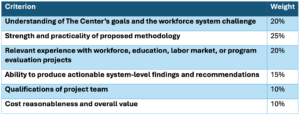
8. Evaluation Criteria
9. Anticipated Timeline
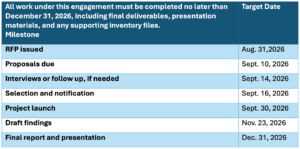
10. Submission Instructions
Proposals should be submitted electronically in PDF format to TheCenter@talentfirst.net no later than 5pm ET on Sept. 10, 2026. Questions regarding this RFP should be submitted in writing to the same contact by Sept. 9, 2026. The Center may share responses to submitted questions with all potential proposers.
The Center reserves the right to accept or reject any proposal, request clarification, negotiate scope and budget, waive informalities, and select the proposal that best meets the needs of the organization.