The demand for healthcare professionals in West Michigan continues to grow. According to regional labor market data, healthcare and social assistance jobs are projected to grow by 8% through 2028, making healthcare the region’s top-growing industry. Yet, even as learner interest increases and healthcare employers face ongoing staffing shortages, bottlenecks continue to limit credential completion, increase student attrition, and slow down economic mobility for many frontline workers.
The release of Pathways to Nursing Credentials in West Michigan: Preliminary Roadmap represents an important step toward addressing these challenges. The report builds on TalentFirst’s broader efforts to strengthen education-to-employment pathways across the region and create more accessible opportunities for adult learners to advance into high-demand careers.
Over the past several years, TalentFirst has worked alongside employers, colleges, workforce organizations, and national partners to explore how stackable credentials can help individuals build skills incrementally while meeting the evolving talent needs of regional industries. That work included a partnership with Third Sector on innovative workforce development and lifelong learning strategies designed to reduce barriers to education and training. Through those conversations, one opportunity stood out: nursing.
Healthcare employers consistently identified workforce shortages across the nursing continuum, while education and workforce partners recognized a significant opportunity to support economic mobility for frontline healthcare workers already serving in patient-facing roles. Stakeholders saw the need for clearer pathways that help Certified Nursing Assistants (CNAs) advance into Licensed Practical Nurse (LPN) and Registered Nurse (RN) careers.
“The nursing pathway didn’t emerge in isolation — it grew out of a broader regional effort to rethink how people access, finance, and navigate education-to-employment opportunities. Our partnership with Third Sector brought together employers, colleges, and workforce leaders around a shared goal: creating clearer pathways for adult learners while helping healthcare employers meet critical workforce needs.” – Alex Andrews, Director of Business Intelligence & Workforce Innovation, TalentFirst
A Regional Partnership Approach
Building sustainable pathways for adult learners requires coordination across sectors. It requires a neutral intermediary to align employer demand, support institutional innovation, and coordinate regional incentives.
To better understand how nursing pathways could be strengthened, TalentFirst partnered with Third Sector to conduct a comprehensive review of nursing credential pathways in West Michigan. The effort was developed with direct input from Grand Rapids Community College (GRCC) and Muskegon Community College (MCC), two institutions that play a critical role in preparing the region’s healthcare workforce.
Together, these partners explored barriers facing learners, examined existing credential pathways, and identified opportunities to improve progression from entry-level healthcare occupations into higher-wage nursing careers. The resulting roadmap outlines strategies that can strengthen both economic mobility and the long-term healthcare talent pipeline.
A key focus of the report is one of the most important—but often overlooked—career pathways in healthcare: helping CNAs advance more efficiently into LPN and RN roles. While pathways from RN to a Bachelor of Science in Nursing (BSN) and beyond are generally well established, pathways originating at the CNA level are often less structured, leaving many workers without clear routes for advancement despite years of hands-on experience.
The Value of Stackable Healthcare Credentials
When we talk about “stackable credentials,” we mean an educational framework that provides clear, modular entry and exit points. Instead of committing to a rigid, multi-year degree program without interim milestones, adult learners can earn shorter-term certificates that immediately carry labor-market value.
The economic return on investment (ROI) for stacking credentials in the nursing field is substantial, with an immediate average wage gain of $34,195 annually.
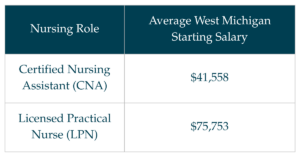
For adult learners, this progression provides rapid access to family-sustaining wages while allowing them to pause, work, or return to higher levels of training as their life circumstances permit. For healthcare employers, fostering internal advancement can reduce recruitment costs, improve retention, and preserve institutional knowledge.
Three Strategic Pillars to Strengthen Nursing Pathways
Drawing from interviews with employers, colleges, and workforce partners, the report outlines a strategic roadmap anchored by three core pillars:
1. Expand Clinical and Instructional Capacity
A primary bottleneck in nursing education is a nationwide shortage of clinical training sites and preceptors (the licensed professionals who supervise students). To overcome this, the report recommends:
- Diversifying Employer Partnerships: Expanding clinical placements beyond traditional hospitals to include long-term care facilities, rehabilitation centers, home health organizations, and behavioral health clinics.
- Flexible Course Delivery: Embedding remote, hybrid, evening, and summer training options to prevent the “stop-out” points that part-time adult learners frequently experience.
2. Reduce Time and Cost to Completion
Adult learners are often balancing full-time employment, families, and tight budgets. Accelerating their timeline to a degree through practices like offering Credit for Prior Learning (CPL) is essential for completion.
MCC’s Life Experience Assessment Program (LEAP) and GRCC’s Prior Learning Assessment Process maximize institutional frameworks and allow incumbent workers to translate years of direct patient care experience into college credit.
In Michigan, CPL programs have been shown to boost college completion rates by 25% for adult community college learners, showing particularly strong positive impacts for low-income students and adult students of color.
3. Strengthen Navigation and Re-Engagement Infrastructure
Many adult students drop out not due to a lack of academic ability, but because of systemic life barriers or confusing transfer processes. Implementing proactive career advisors and college navigators who understand the lived realities of working adults makes a difference in completion rates.
Identifying the “some college, no degree” healthcare workers, and providing support for their return to school continues to strengthen the healthcare talent pipeline. The report recommends building a unified regional system to reach out to non-completers and waitlisted students to support their return to a pathway when capacity opens.
Existing Regional Strengths
The report emphasizes that West Michigan is not starting from scratch. West Michigan community colleges are already leading important work. For example, Muskegon Community College maintains a 100% National Council Licensure Examination for Practical Nurses (NCLEX-PN) pass rate – well above the national average of 86.7% – and has the highest transfer-out rate in the state (34%), offering bridge programs to institutions like GVSU and MSU. Meanwhile, Grand Rapids Community College is actively expanding its prior learning assessments and developing partnerships with regional employers like University of Michigan Health-West to secure paid tuition structures for its nursing cohorts.
Additionally, a local CNA-to-LPN Apprenticeship Pilot launched in 2024 with West Shore Community College and the Michigan Workforce Training and Education Collaborative (MWTEC) has shown early promise, yielding a 100% pass rate among the cohort that completed the pilot.
Explore the Full Report
The preliminary roadmap is a resource for educators, healthcare executives, policymakers, and workforce advocates across Michigan. By aligning our resources and validating the hard-earned experience of adult workers, we can address regional talent needs and support long-term economic mobility for adult learners and their families.
We encourage all blog readers, regional stakeholders, and education advocates to explore the data, strategies, and full breakdown of recommendations.
Download the Pathways to Nursing Credentials in West Michigan report today to see how we can build a more equitable, efficient, and stronger healthcare talent pipeline together.